Sourcing Pleated Dress Pants for wholesale requires more than comparing factory prices. A buyer must evaluate fabric, construction, grading, and finishing together. A trouser sample can look elegant online, yet feel stiff under real movement. That gap matters.
Menswear writer Simon Crompton often stresses that “fit is the foundation of style.” This principle applies directly to wholesale pleated trousers. The pleat must open cleanly without pulling across the stomach. The waistband should sit securely. The crease should remain sharp after pressing and packing. Small details become expensive problems when multiplied across hundreds of units.
Begin by defining the customer and selling environment. Office retailers may prefer wool blends, restrained pleats, and a 30-inch inseam range. Contemporary brands may request wider legs, heavier twill, or adjustable side tabs. Ask suppliers for fabric composition, shrinkage data, GSM, colorfastness results, and production tolerances. Request physical samples, not only photographs.
Inspect the inside. Look at pocket bags, belt loops, zipper guards, seam density, and bar-tack placement. Test the pleats after sitting, walking, and steaming. They should recover without leaving shiny press marks. Not perfect yet.
A reliable supplier should explain minimum order quantities, lead times, replacement policies, and inspection procedures clearly. A pre-production sample can expose weak stitching or an awkward rise before bulk cutting begins. Still, buyers sometimes overvalue appearance and underestimate fit consistency. That is a mistake worth revisiting.
This guide will examine supplier selection, sampling, cost control, quality inspection, and shipment planning. The goal is practical sourcing: attractive Pleated Dress Pants that remain comfortable, consistent, and commercially dependable.
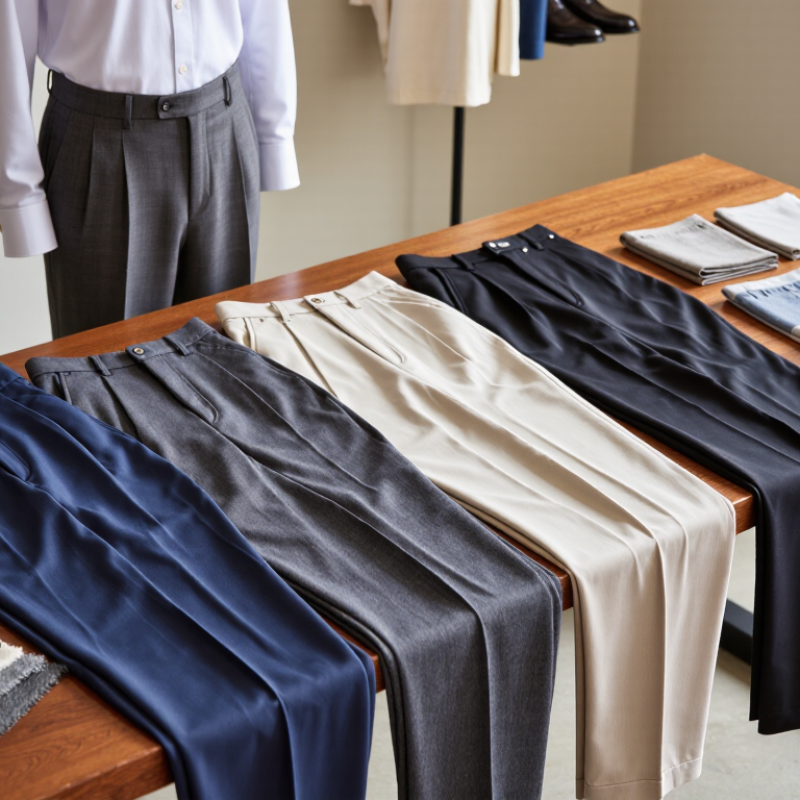
Define Your Wholesale Pleated Dress Pants Requirements
Before contacting factories, define the product on paper. Specify the rise, waistband construction, pleat direction, leg shape, hem finish, and pocket depth. Give finished measurements, not only a size chart. In sampling work, a two-centimeter hip difference can change the drape noticeably. Your target customer also matters. Office buyers may prefer a firm wool blend, while value retailers may need easy-care polyester. Textile Exchange’s Materials Market Report 2024 recorded 124 million tonnes of global fiber production in 2023. That scale makes fiber traceability worth specifying early.
Set commercial requirements beside design details. State the target cost, minimum order quantity, size range, color count, packing method, and delivery window. Request fabric weight, composition, shrinkage results, colorfastness data, and seam-strength testing. For pleated trousers, ask suppliers to test pleat recovery after washing and pressing. A polished sample can hide weak performance. The State of Fashion 2025, published by The Business of Fashion and McKinsey, describes continued pressure on margins and cautious consumer spending. Therefore, avoid adding decorative details without a clear selling reason. I sometimes over-specify the first sample. That slows decisions.
Tips: Build one measurement sheet. Add tolerance limits. Approve a physical fabric swatch. Compare at least three quotations. Record every revision with a date. Do not assume “premium” means durable. Ask for test evidence, then check it independently.
Research Suitable Manufacturers and Wholesale Suppliers
Researching suitable manufacturers is the critical step when sourcing pleated dress pants wholesale. Begin with factories experienced in tailored trousers, not only general apparel production. Ask for recent samples, production photos, fabric test reports, and references from comparable buyers. A reliable manufacturer should explain pleat construction, waistband stability, seam allowance, pressing methods, and shrinkage control.
Data can guide material discussions. Textile Exchange’s 2024 Materials Market Report states that polyester represented about 57% of global fiber production in 2023, while recycled polyester accounted for roughly 12% of polyester output. Request exact fiber percentages and certification evidence rather than accepting vague “eco” claims. For office trousers, compare polyester-viscose blends, wool blends, and recycled options through abrasion, colorfastness, and pilling tests. Small details matter. Pleats must recover after sitting.
Wholesale suppliers may offer lower minimum order quantities, faster delivery, and mixed-size purchasing. However, their prices can hide weaker inspection controls or unclear factory origins. The McKinsey State of Fashion 2024 projected only low single-digit industry growth, increasing pressure on buyers to protect margins and reduce unsold stock. Request a complete quotation covering sampling, grading, packaging, freight terms, and defect allowances.
I would test two suppliers with identical specifications. Their first samples may expose inconsistent pleat depth or uneven hems. That is useful evidence, not a minor inconvenience. Keep a measurement sheet, approve a pre-production sample, and inspect random cartons before shipment. A perfect supplier rarely appears immediately.
How to Source Pleated Dress Pants for Wholesale
Typical planning timeline for researching manufacturers, developing samples, approving fit, producing bulk orders, and arranging quality control and shipping.
The figures represent practical apparel-sourcing planning benchmarks in weeks. Actual lead times depend on fabric availability, order quantity, sample revisions, production capacity, and shipping method.
Request Samples and Verify Quality Before Ordering
How to Source Pleated Dress Pants for Wholesale
Requesting samples is the most practical quality check before placing a wholesale order. Pleated dress pants can look elegant in photos but fail during movement. Check the waistband recovery, pleat symmetry, pocket strength, zipper operation, and pressing quality. Try the sample on several body types. Sit, walk, and bend in it. A rigid waistband may impress during inspection but create complaints after eight hours of wear.
Material selection deserves equal attention. Textile Exchange reported that global fiber production reached 124 million tonnes in 2023, with polyester representing about 57%. This explains its popularity, but fiber content alone does not prove comfort or durability. Request fabric composition, weight, shrinkage results, colorfastness tests, and pilling performance. Compare the approved sample with the production sample. Small differences in fabric hand or pleat depth can change the entire product. The NRF and Appriss Retail estimated that 16.9% of U.S. retail sales were returned in 2024, showing why preventable fit problems can become expensive.
Tips: Ask for two samples from different production batches. Measure the waist, rise, inseam, leg opening, and pleat spacing. Photograph each measurement. Wash one sample according to care instructions. Inspect it again after drying. Do not approve too quickly. A perfect showroom sample may hide inconsistent stitching, and even careful checks can miss problems. Recheck before payment.
How to Source Pleated Dress Pants for Wholesale - Request Samples and Verify Quality Before Ordering
Pre-order sample comparison and quality verification reference
| Sample Batch |
Fabric Composition |
Fabric Weight |
Pleat Construction |
Sample Lead Time |
Minimum Order Quantity |
Estimated Unit Price |
Key Quality Checks |
Pre-Order Decision |
| Sample A |
65% polyester / 33% rayon / 2% elastane |
280 g/m² |
Double front pleat; reinforced waistband and belt loops |
7–10 calendar days |
100 pieces per color |
US$9.80–12.50 per piece |
Check pleat symmetry, fabric recovery after stretching, waistband stability, zipper operation, and seam straightness. |
Suitable for bulk review |
| Sample B |
80% polyester / 18% rayon / 2% elastane |
240 g/m² |
Single front pleat; concealed hook-and-bar closure |
5–8 calendar days |
150 pieces per color |
US$8.40–10.90 per piece |
Verify opacity under strong light, resistance to shine at the seat and knees, pocket-bag durability, and color consistency. |
Request revisions |
| Sample C |
55% polyester / 43% wool / 2% elastane |
310 g/m² |
Double forward pleat; half lining to the knee |
10–14 calendar days |
80 pieces per color |
US$16.50–21.00 per piece |
Confirm fiber composition, lining attachment, dimensional stability after care testing, pilling resistance, and odor control. |
Suitable for premium range |
| Sample D |
100% polyester |
210 g/m² |
Single pleat; standard stitched waistband |
6–9 calendar days |
200 pieces per color |
US$6.20–8.00 per piece |
Inspect static buildup, fabric transparency, loose threads, pressed-crease durability, and measurement tolerance. |
Do not order yet |
| Sample E |
70% polyester / 28% viscose / 2% elastane |
260 g/m² |
Double pleat; extended waistband tab with internal grip tape |
8–12 calendar days |
120 pieces per color |
US$10.20–13.80 per piece |
Test waistband comfort, pleat retention after pressing, shrinkage after washing, hem balance, and size grading from waist to hip. |
Suitable for final quotation |
Recommended approval rule: Order a pre-production sample, measure at least three points per size, perform one care-cycle test, and confirm that the approved sample matches the bulk-production specifications before placing the wholesale order.
Compare Costs, Terms, Production Times, and Shipping Details
When sourcing pleated dress pants wholesale, compare the full landed cost, not only the factory quote.
Ask for fabric weight, fiber content, pleat construction, pressing, labels, packing, and inspection fees. A low unit price may hide expensive alterations. The 2024 McKinsey–BoF State of Fashion report identifies supply-chain volatility as a continuing business risk. Build a 5–10% contingency for material changes and rework.
Terms matter as much as price.
Request the minimum order quantity, sample fee, payment schedule, defect allowance, and cancellation conditions in writing. For new suppliers, staged payments can reduce exposure. However, stricter terms may increase the quoted price. Trade-offs are real. I have seen buyers focus too heavily on discounts and overlook inconsistent waistband measurements. That mistake can damage repeat orders.
Production timing should include fabric booking, sample approval, bulk sewing, pressing, inspection, and export preparation.
Allow extra days around holidays and peak seasons. Freight planning also needs detail. UNCTAD reports that maritime shipping carries over 80% of global trade by volume, so port delays can affect delivery dates.
Compare sea, rail, and air quotations using carton count, gross weight, dimensional weight, fuel surcharges, duties, and destination fees. The World Bank’s 2023 Logistics Performance Index shows meaningful differences in customs and delivery reliability between markets. Ask for a realistic ship date, not an optimistic promise. A written timeline with inspection checkpoints is more useful than a vague “fast production” claim.
Conclusion
Sourcing Pleated Dress Pants for wholesale begins with clearly defining your requirements, including target customers, preferred styles, fabric composition, size range, colors, order quantities, and customization needs. With these details established, buyers can research suitable manufacturers and wholesale suppliers that match their product standards and business goals. It is important to evaluate fabric quality, stitching, waistband construction, fit, sizing consistency, and available design options before making a decision.
Requesting samples is an essential step for checking comfort, appearance, durability, and overall workmanship. After reviewing samples, compare supplier pricing, minimum order quantities, payment terms, production schedules, packaging, and shipping arrangements. A careful comparison helps buyers control costs, reduce quality risks, and choose a reliable supply partner for consistent Pleated Dress Pants production. Clear communication and written agreements can also support smoother ordering and long-term cooperation.